| PENN | |
| NEWS |
| Class of 2003 News |
| Admissions News |
| What's New at Penn |
| Penn Census Facts |
| Did You Know? |

Very Selective (and Only Slightly More Expensive) It has become a refrain in recent years, and a welcome one at that: The tuition increase for the upcoming academic year is the smallest in three decades, while the acceptance rate for the incoming Class of 2003 is the most selective in Penn's history. Tuition and fees for undergraduates will increase 4.2 percent, from $23,254 to $24,230, while the overall student charges will increase 3.7 percent, from $30,460 to $31,592. "This maintains our commitment to limit the rate of increase for both tuition and total student charges for our undergraduates at Penn," said President Judith Rodin, who added that the total charges are expected to be the lowest in the Ivy League. Rodin also noted that the trustees are "resolutely committed" to the University's campaign to raise $200 million to beef up the endowment for undergraduate financial aid. So far, $73 million has been raised. Meanwhile, of the record-high 17,649 students who applied to Penn this year (up from 16,658 a year ago), only 4,703 were accepted. That 26.6 percent acceptance rate is the lowest ever at Penn. Approximately 40 percent of those admitted had applied for early decision, and 350 were children of alumni. reprinted from the Pennsylvania Gazette, May 1999 |
Overall:
16,658 applicants
2,125 early
14,533 regular
4,842 admits (29%)
786 early (37%)
4,056 regular
2,396 matrics (49.5%)
111 deferred (17%)
Average SAT: 1401
DISTRIBUTION OF THE COLLEGE BOARD TEST SCORES
| Verbal | Math | |||||
| SAT Range | Applied | % Accepted | Enrolled | Applied | % Accepted | Enrolled |
| 750-800 | 2000 | 52% | 403 | 3281 | 45% | 639 |
| 700-740 | 3107 | 43% | 626 | 4394 | 35% | 754 |
| 650-690 | 4005 | 32% | 683 | 4060 | 26% | 590 |
| 600-640 | 3431 | 22% | 438 | 2567 | 20% | 287 |
| 550-590 | 1921 | 15% | 181 | 1152 | 16% | 106 |
| 500-540 | 991 | 10% | 56 | 453 | 5% | 16 |
| Under 500 | 689 | 4% | 11 | 237 | 3% | 6 |
| Total* | 16,658 | 29% | 2,414 | 16,658 | 29% | 2,414 |
Total includes ACT testing only and incomplete testing applicants
ACA Admissions:
840 applicants
300 early
540 regular
396 admits (47.2%)
154 early
242 regular
262 matrics (66%)

By Andrew Ribner
The Daily Pennsylvanian
If the numbers are any indication of things to come in terms of regular-admissions applications, next fall's incoming freshman class will probably be the best one Penn has even seen --again.
According to a preliminary tally, early applications for undergraduate admission to the University's Class of 2003 rose 1.9 percent this fall to an all-time high of 2,165, up from last year's previous record of 2,125 for the Class of 2002.
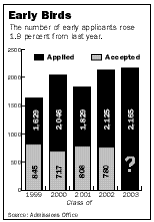 And the quality of students rose, too: The average
SAT score of early applicants this year jumped seven points to 1339, and their average
rank is in the top 5 percent of their high school class, versus the top 6 percent for last
year.
And the quality of students rose, too: The average
SAT score of early applicants this year jumped seven points to 1339, and their average
rank is in the top 5 percent of their high school class, versus the top 6 percent for last
year.
This is the second year in a row that there has been an increase in early applications, which for Penn and several other members of the Ivy League were due November 1. Last year's 10 percent increase was a rebound from a 10 percent decrease in 1996, after a well-publicized crime wave hit campus, discouraging potential applicants.
Since then, Penn has jumped several places in the closely watched U.S. News and World Report rankings, into a three-way tie with Cornell and Duke universities for No. 6 among major universities, up from seventh last year.
"Penn is becoming more and more recognized by stronger students academically," Admissions Dean Lee Stetson said. "More students are coming to Penn as a first choice."
Officials expect 35 to 40 percent of the Class of 2003 to come from the early-applicant pool. Last year, 37 percent of early applicants were admitted in December, compared with 44 percent for the Class of 2001.
Early applications from minority students also rose 7.1 percent -- from 708 to 758 -- following a smaller increase the year before. That number includes 73 applications from African American students, up from 65; 625 from Asian Americans, an 8.5 percent jump from 576 last year; and 49 from Latino students, up from 43.
The only significant decline in early-decision applications were those from alumni families, falling from 303 to 263.
Though Stetson was not sure why applications from legacies fell, he speculated that "some alumni feel that admission isn't as guaranteed as they hoped."
New records for early-decision applications were set in four western states as the Admissions Office received 156 applications from California, 63 from Texas, 16 from Washington and 15 from Colorado.
Interest from the Northeast continued to be strong as New Jersey, New York and Pennsylvania together accounted for just under half of all early applications.
Early applications from foreign students also set a record this year, increasing to 211 from 206.
Three undergraduate schools saw a jump in early applications: the College of Arts and Sciences with 1,289 compared with 1,239; the School of Engineering and Applied Science, with 261, eight more than last year; and the Nursing School with 30, three more than a year earlier.
Wharton applications fell to 584 from 606, though Stetson noted that when including Wharton's various dual-degree programs, the school's early applications rose to 767 from 728.
By gender, women sent in 923 early applications, up from 905 while men sent in 1,242, compared to last year's 1,220.
Students who apply early-decision must sign a waiver of their intention to matriculate at the particular school should they apply early. Responses from the universities are mailed by December 15, and most applicants who are not accepted are deferred to the regular applicant pool.
This contrasts with the January 1 application deadline for regular-decision applications, which do not require applicants to pledge matriculation to a particular school.
The sounds for construction equipment echo off the back of College Hall. Visitors to campus are struck by the many physical changes already completed or currently underway at Penn.
Logan Hall, home to the College of Arts and Sciences, reopened this past January as it was brought back to its original 1874 splendor following seven years of renovations. The Vagelos Laboratories, home of the Institute for the Advancement of Science and Technology, opened in January as well, providing an additional 100,000 square feet of world-class laboratory facilities for programs in chemistry, chemical engineering and the Institute for Medicine and Engineering.
The new University of Pennsylvania Bookstore opened in August at its new location in Sansom Commons, Walnut Street between 36th and 37th streets. Next September, the Inn at Penn, a multi-purpose hotel/conference center, will welcome guests at its location next to the new Bookstore. Van Pelt Library, the center for Penn's social science and humanities collections, is currently nearing completion of renovations designed to offer students the best of both print and electronic resources.
Closer to College Hall, Houston Hall and Irvine Auditorium have been closed for several months now as construction and renovations commence with the new Perelman Quadrangle, an innovative plan to link academic and social facilities, offering even more opportunities for student and faculty collaboration outside of the traditional classroom setting. A similar theme is central to the new College House system, offering every undergraduate student the chance to form a distinct shared community within the larger context of Penn's campus.
DID YOU KNOW...
* The new Penn Bookstore opened on July 15th?
* The Department of Geology has been renamed The Department of Earth
and Environmental Science?
* On Friday, July 3rd, Le Bus closed its doors on campus? :(
* Logan Hall has (finally) reopened?
* Penn, The School District of Philadelphia, and the Philadelphia
Federation of Teachers will jointly establish a
university-assisted
PreK-8 public school in West Philadelphia which is
scheduled to open
in two years?
* The E. Craig Sweeten Alumni Center has officially changed its name
to the E. Craig Sweeten Alumni House, and that there are
plans to
create a hospitality suite within the building, to help
make visits
to Penn feel like a return to home?
* Penn has been the home to a number of significant Firsts. For example:
1756--First modern liberal arts curriculum
1765--First Medical School
1886--First performance of a classical Greek
comedy
1895--First laboratory for clinical medicine
1940--First commercially televised football
game
1946--First all-electronic general purpose
digital computer (ENIAC)
1952--First televised surgical operation
1978--First entirely Student-Run Cable TV
Station
1992--First Institute for Human Gene Therapy
* Penn is changing its name to The University of
Center City
That's All For Now..................